


American actor


I Transcend in order to Know. Enduring healing. I seal the process of accomplishment with the cosmic tone of presence. I am guided by the power of Blue Monkey.
 Guiding Power is an overseeing and directing energy providing protection, clarity and guidance. Your Guiding Power is the same color as your sign — you share similar energy. Your perfect guide carries the same tone as you.
Blue Cosmic Monkey
Guiding Power is an overseeing and directing energy providing protection, clarity and guidance. Your Guiding Power is the same color as your sign — you share similar energy. Your perfect guide carries the same tone as you.
Blue Cosmic Monkey
 The Antipode is a challenge power which counterbalances and strengthens — your mirror to your inner world. Antipodes can serve as teachers who remind us to make good choices.
Red Cosmic Earth
The Antipode is a challenge power which counterbalances and strengthens — your mirror to your inner world. Antipodes can serve as teachers who remind us to make good choices.
Red Cosmic Earth

 Your own tribe — the seal you carry through the count. Click to meet the whole tribe.
Blue Cosmic Hand
Your own tribe — the seal you carry through the count. Click to meet the whole tribe.
Blue Cosmic Hand
Kin 247 rides the Blue Eagle wavespell · kin 235–247


 Destiny Path
Your 52-Year Destiny Path is easy to follow on Space Station Plaza. Simply scroll down to see your life journey mapped from birth through age 104.
The cycle begins at age 0 with your Galactic Signature. Each year, your path moves through the four Solar Seals of your Earth Family while advancing by one of the 13 Galactic Tones. Together, the seal and tone reveal the energetic theme of each journey around the Sun.
On your 52nd birthday, you return to the same Galactic Signature you carried at birth. One complete Destiny Path has been fulfilled, and a new 52-year cycle begins. This marks your passage into elderhood—but you might think of yourself as a “baby elder,” entering a second childhood filled with renewed wonder, wisdom, and possibility.
Samuel's birthdate — December 21, 1948 — cast across every system aboard the station.
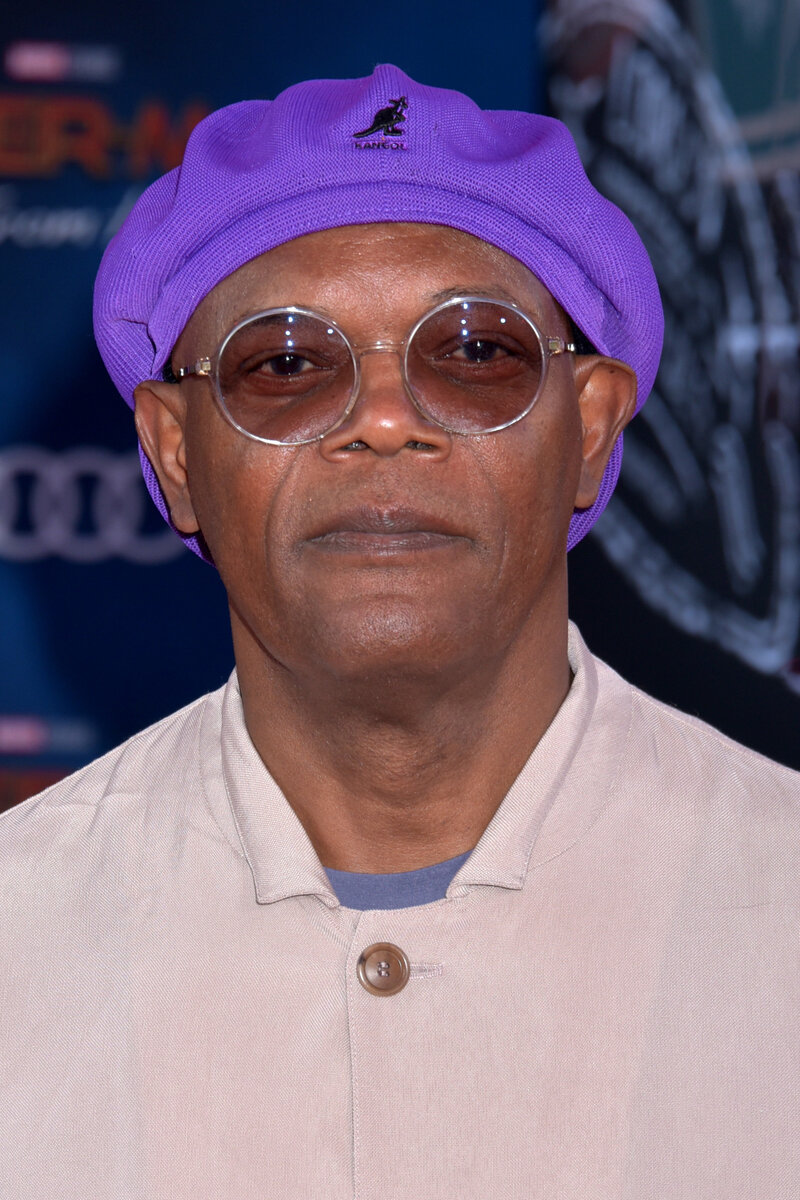
Samuel L. Jackson in 2019. Photograph by Glenn Francis, licensed CC BY-SA 4.0 via Wikimedia Commons.
Birth: December 21, 1948 — Washington, D.C., United States
Known for: Actor, producer, activist, and one of the defining screen presences of modern cinema
Galactic Signature: Kin 247 — Blue Cosmic Hand
Dreamspell Tribe / Solar Seal: Blue Hand
Mayan Usage: Manik — Deer
Galactic Tone: Cosmic Tone 13 — Presence, Endurance, Transcendence
Wavespell: Blue Eagle Wavespell — Day 13, the transcendent culmination of Vision, Mind, and Creative Perspective
Castle: Green Central Castle of Enchantment
Interplanetary Holon: Earth
Destiny / Oracle Pattern: Guide — Blue Cosmic Monkey; Analog — Yellow Cosmic Human; Antipode — Red Cosmic Earth; Occult / Hidden Gift — White Magnetic Wizard
Destiny Card: Ten of Hearts
Western Astrology: Sagittarius Sun
Chinese Astrology: Earth Rat
Numerology: Life Path 1
Kin affirmation: I endure in order to know. Transcending healing, I seal the store of accomplishment with the Cosmic tone of presence. I am guided by the power of magic.
Samuel L. Jackson’s Galactic Signature is one of embodied knowledge. Blue Hand carries the powers of knowledge, accomplishment, healing, and completion. Its wisdom is rarely satisfied with theory alone. It wants experience that can be touched, practiced, tested, and made real. For an actor, the “hand” is larger than the literal hand: it is the whole physical instrument—breath, voice, eyes, posture, timing, memory, gesture, rhythm, and the nervous system’s ability to remain present while another identity moves through the body.
Jackson’s career makes this principle unusually visible. His authority does not come only from the words in a screenplay. It comes from what he physically does with them. He attacks a consonant, holds a silence, changes the temperature of a room with a glance, stretches a sentence into a threat, or turns profanity into percussion. His performances feel handmade. Even when he is playing a mythic franchise figure, his craft retains bodily texture: irritation, delight, suspicion, rage, wit, grief, and watchfulness remain alive beneath the icon.
The Cosmic Tone brings Blue Hand to Tone 13, the frequency of presence, endurance, and transcendence. Tone 13 is the final movement of a thirteen-stage process. It carries the coda, the completed work, and the mysterious moment when an accomplishment becomes larger than its maker. Jackson’s life did not follow the mythology of instant discovery. He spent years in theater, small screen roles, stand-in work, and supporting parts before his major cinematic emergence in his forties. His signature therefore speaks not simply of success, but of the long endurance required for mastery to become undeniable.
Kin 247 is also Day 13 of the Blue Eagle Wavespell. The Eagle sees; the Hand realizes. Eagle supplies perspective, imagination, and the ability to view the entire field. Hand brings that vision down into the body and completes it. Jackson’s astonishing range—from Spike Lee dramas and Tarantino’s moral underworlds to Star Wars, Marvel, animation, action cinema, intimate theater, satire, horror, and commercials—suggests a performer who can see the operating language of many different cinematic worlds and then make himself function inside each one.
This is the culminating lesson of the Blue Eagle Wavespell: vision becomes meaningful when it is embodied. Jackson does not merely imagine authority, danger, intelligence, outrage, or moral conflict. He gives those forces a voice and a nervous system. He places the vision in human hands.
In the traditional Maya day-sign current, Manik is commonly translated as Deer. This reading honors Manik as an ancestral Maya current while keeping it distinct from the modern Dreamspell seal of Blue Hand. The two are placed in respectful dialogue, not treated as historically identical systems.
The Deer image adds sensitivity, alertness, and ceremonial bearing. A deer survives through acute perception: it reads the field, detects subtle changes, and knows when stillness is more powerful than motion. Jackson’s screen presence often works this way. His characters scan. Nick Fury measures the room before revealing what he knows. Elijah Price in Unbreakable observes patterns others cannot yet see. Jules Winnfield notices the impossible interruption in an execution and interprets it as a sign. Even Jackson’s loudest performances are frequently anchored in watchfulness.
Manik also brings the suggestion of service and sacred responsibility. The mature Hand does not accumulate skill merely to display superiority. It becomes capable of holding something for the community: a story, a warning, an ancestral memory, a moral confrontation, or a form of cultural representation. Jackson’s career has repeatedly placed a Black man’s intelligence, fury, humor, vulnerability, and command at the center of genres that historically narrowed or excluded such presence. The work is entertainment, but it also changes what authority can look and sound like on the screen.
Jackson grew up in Chattanooga, Tennessee, and has spoken publicly about living with a serious childhood stutter. He learned, in part, to speak by imagining himself as other people who did not stutter; acting became a passage into fluency. This is one of the deepest Blue Hand correspondences in his story. A difficulty in physical expression was not simply “defeated.” It became knowledge. Through repetition, breath, characterization, and vocal practice, the wound became part of the instrument.
The signature does not imply that hardship exists in order to produce greatness. It suggests something more ethical and more human: experience can become embodied knowledge when it is consciously worked. Jackson’s famous verbal force therefore has an unseen history. What audiences experience as effortless command emerged from contact with vulnerability. Blue Hand healing does not erase the scar; it teaches the body a new relationship to it.
Even Jackson’s signature use of a certain emphatic profanity has been connected by him to moving through speech blocks. What became a cultural trademark also functioned as a physical key. Blue Monkey, his Guide, is clearly present here: language becomes play, disruption, surprise, and a magical trick that opens a locked gate. The word breaks tension, restores rhythm, and returns speech to the body.
At Morehouse College, Jackson’s path moved through science, social consciousness, and eventually drama. Following the assassination of Martin Luther King Jr., he served as an usher at King’s funeral and became increasingly involved in activism. In 1969, he participated in a campus action in which members of Morehouse’s board were confined while students demanded changes in governance and curriculum. He was suspended, later returned, and completed his degree.
This chapter reveals both the light and shadow potentials of Hand. Blue Hand acts. It is not content with purely conceptual agreement when it believes repair is required. Yellow Human support brings questions of free will, social influence, and ethical choice; Red Earth challenge asks whether action is aligned with timing, context, and consequence. The desire to force change can arise from a legitimate recognition that something is broken, yet the method remains morally consequential. Mature Hand wisdom joins agency with accountability.
Jackson’s lifelong public engagement with social and political issues shows that his acting career did not entirely replace the activist current. Instead, the current entered his selection and embodiment of roles. Films such as Do the Right Thing, Jungle Fever, A Time to Kill, Eve’s Bayou, Coach Carter, Django Unchained, and The Last Full Measure place race, justice, education, power, memory, and moral choice inside popular narrative forms.
Jackson’s professional development included stage work, ensemble training, and years of small roles. He appeared in the New York theater world and originated roles in important works, including August Wilson’s The Piano Lesson. He worked repeatedly within ensembles before the larger culture recognized him as a star.
This long apprenticeship is Cosmic Hand territory. The Hand learns by doing, and Cosmic Tone endures the process beyond the point at which ego demands immediate reward. The eventual authority of Jackson’s acting is inseparable from those years. He learned how a scene is built, how another actor’s energy changes the moment, how to sustain a role across a production, and how to remain specific even without the camera’s full attention.
Decades later, his return to The Piano Lesson on Broadway—this time as Doaker Charles, in a production directed by his wife LaTanya Richardson Jackson—formed a literal coda. Cosmic Tone does not merely move forward. It revisits earlier material at a higher octave. The young actor who helped originate an August Wilson role returned as an elder custodian within the same dramatic lineage. The Hand completed a circle.
Jackson has been candid about addiction and rehabilitation. Shortly after leaving treatment, he played Gator Purify, a man devastated by crack addiction, in Spike Lee’s Jungle Fever. The role was acclaimed and became a decisive career breakthrough.
This correspondence must be handled carefully. Addiction is not an archetypal ornament, and a Galactic Signature should never romanticize suffering. Yet the documented sequence has profound symbolic resonance: a lived crisis was followed by treatment, and then by a performance that required him to embody a version of the very force he was working to survive. The Hand’s knowledge became immediate, physical, and unsentimental.
Gator is not a simple victory figure. He shows the cost of disintegration—to self, family, trust, and community. By playing him after rehabilitation, Jackson did not transform addiction into a glamorous badge. He gave dissonance a truthful human form. Cannes created a special supporting-actor recognition for the performance, and the industry began to see what years of craft had made possible.
Here Blue Hand’s healing is not “being healed once and forever.” It is the accomplishment of entering recovery, accepting help, and completing the next right action. Cosmic endurance means remaining present through the long continuation of that choice.
Jules Winnfield remains Jackson’s defining role because the character contains nearly the entire Kin 247 pattern. Jules begins as a professional hand of violence: technically skilled, ritualized, controlled, and terrifyingly competent. He performs a borrowed biblical speech as an instrument of domination. Knowledge has become execution; presence has become intimidation; charisma has become enchantment in service to death.
Then an apparent miracle interrupts the pattern. Bullets fail to strike Jules and Vincent. The event does not mechanically prove a spiritual interpretation, but Jules chooses to treat it as a sign. This is Red Earth, the Antipode, entering through synchronicity: reality disrupts the established route and demands navigation. Vincent sees coincidence; Jules sees a turning point. Yellow Human support appears as free will—the freedom to assign meaning, change direction, and refuse the next repetition.
At the diner, Jules confronts Pumpkin and Honey Bunny. The old Hand could complete the situation through violence. Instead, he holds the field, protects himself and others, relinquishes money, and chooses a different ending. The scene does not make him innocent. It reveals the beginning of accountability. He revises the meaning of his ritual speech and recognizes that he may have been the tyranny rather than the righteous man.
This is Harmonic Wisdom as drama: dissonance moving toward consonance without pretending the dissonance never occurred. Jules does not erase his past. He changes what his hands will do next. His final aspiration—to walk the Earth and discover who he is—joins Hand to the Red Earth challenge with extraordinary precision. He stops executing a predetermined role and begins navigating.
Blue Monkey guides the whole performance through dark wit, verbal improvisational energy, and theatrical danger. White Magnetic Wizard is the hidden gift: the diner enters suspended time while Jules’ charisma holds everyone in a single field. Yet the deepest magic is not his power over others. It is his capacity to interrupt himself.
Nick Fury is a Blue Eagle–Blue Hand figure: the seer who surveys threats across a planetary field and assembles individuals into coordinated action. Fury rarely possesses the most spectacular superpower. His power is strategic knowledge—seeing where abilities belong, recognizing danger before institutions do, and turning isolated talent into an accomplished mission.
Fury also embodies the shadow of surveillance and control. Vision can become suspicion; leadership can become manipulation; the belief that one sees the whole board can diminish the autonomy of others. Yellow Human support asks whether influence honors free will. Red Earth asks whether strategy remains grounded in the living reality of the people being moved across the board.
Mace Windu expresses mastery, physical discipline, ceremonial authority, and allegiance to an order. The purple lightsaber—famously connected to Jackson’s desire to locate himself visibly within a large battle—became a perfect Blue Hand symbol: a distinctive tool that makes presence legible inside a vast composition.
Windu’s shadow is institutional certainty. His skill is unquestioned, but mastery inside an inherited structure can become rigidity. The Hand may know how to perform the established task while failing to perceive that the entire system is approaching rupture. This is where Red Earth’s evolutionary challenge becomes essential: technique must remain responsive to the changing field.
In Unbreakable and Glass, Elijah Price is a dark mirror of Blue Hand. Physically fragile, he compensates through pattern recognition, design, and obsessive knowledge. He sees what others cannot and attempts to force reality to confirm his vision. The wound becomes identity; knowledge becomes manipulation; accomplishment becomes the engineering of catastrophe.
This is wounded Hand at its most dangerous: “Because I understand the pattern, I am entitled to control the people inside it.” White Wizard’s enchantment turns coercive. Blue Eagle vision loses compassion. Yellow Human free will is violated. Elijah’s tragedy is not his bodily condition; it is the moral distortion through which he makes other lives serve his need for meaning.
Frozone reveals the Blue Monkey guide in lighter form. His competence is elegant, playful, rhythmic, and socially connected. The character’s powers require movement and environmental awareness; he creates pathways while in motion. Jackson’s vocal performance gives the superhero a relaxed musicality that makes technique feel like pleasure rather than burden.
In Coach Carter, the visible goal is athletic success, but the deeper accomplishment is education, discipline, choice, and a future beyond immediate applause. This is Blue Hand supported by Yellow Human wisdom. Skill without agency is incomplete. The students must decide what their talent will serve.
Jackson’s Carl Lee Hailey forces the viewer into an agonizing field of grief, vengeance, law, race, and parental protection. The performance cannot be reduced to a simple archetypal endorsement. It asks what happens when the hand acts because institutions have repeatedly failed to protect. Red Earth’s challenge is unavoidable: consequence, history, and social context shape every judgment. The role demonstrates Jackson’s ability to make moral conflict bodily rather than abstract.
Major Marquis Warren in The Hateful Eight uses story, provocation, intelligence, and violence as survival tools inside a sealed chamber of distrust. Stephen in Django Unchained uses perception and influence in service to a brutal order. Together, the roles display opposite but related shadows of knowledge: knowledge as adaptive resistance, and knowledge as complicity with domination.
Jackson’s willingness to embody characters who are abrasive, compromised, frightening, or morally contaminated is part of his Cosmic range. Healing art does not always present healed people. Sometimes it exposes the intelligence by which destructive systems reproduce themselves.
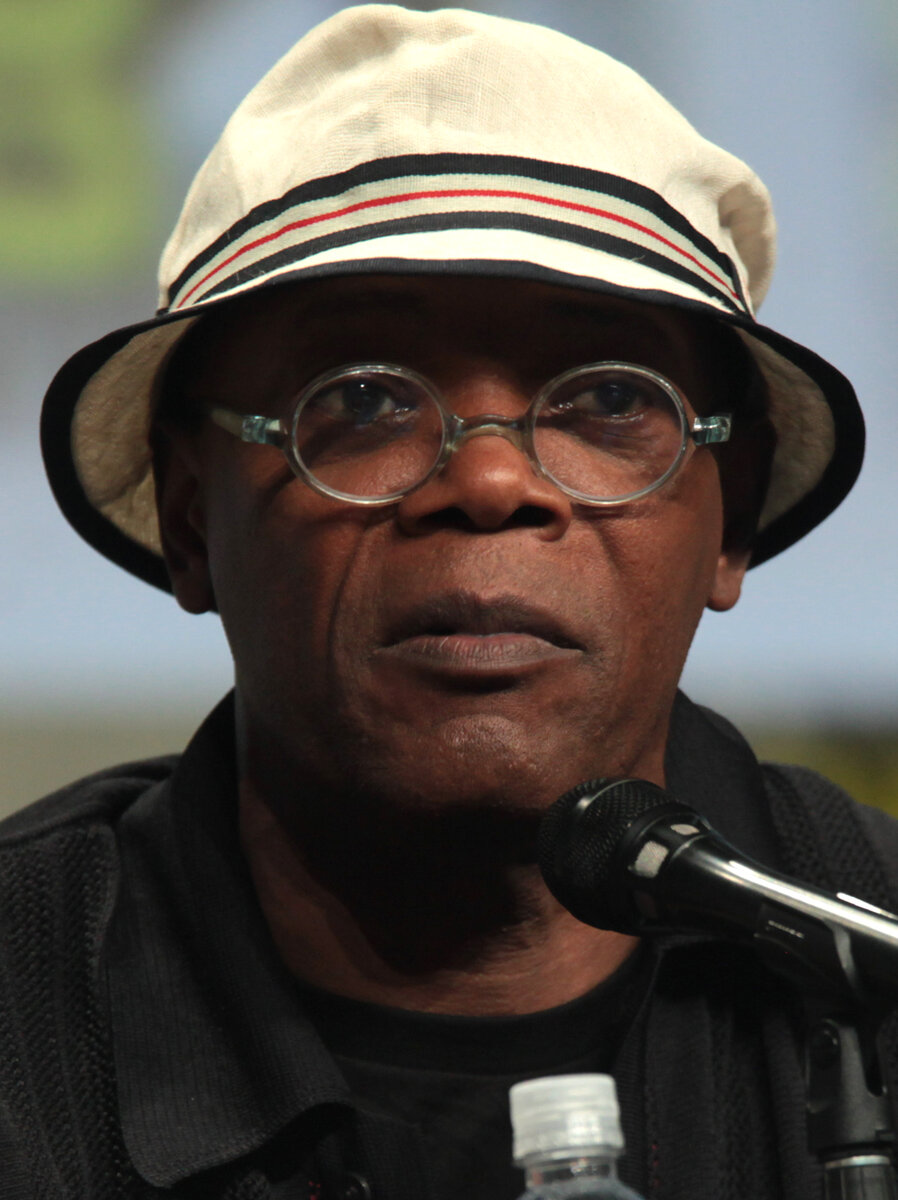
Samuel L. Jackson at San Diego Comic-Con in 2014. Photograph licensed CC BY-SA 2.0 via Wikimedia Commons.
Blue Monkey guides Jackson through magic, play, illusion, humor, improvisation, and the recovery of innocence. Because Hand and Monkey both carry blue transformational energy, his mastery is not meant to become stiff. The guide keeps technique surprising.
Jackson’s humor is often inseparable from danger. A slight shift in vocal rhythm can make a threat absurd, then terrifying, then funny again. This is Monkey’s theatrical intelligence: it reveals that social reality is partly constructed through tone, role, costume, and expectation. Jackson understands the mask and lets the audience see both the mask and the force beneath it.
The Monkey shadow is trickery used to avoid pain or accountability. Persona can become a permanent defense. The mature guide restores play without trivializing suffering. Jackson’s enormous enjoyment of genre, action figures, costumes, and his own performances suggests a performer who has preserved an active relationship with the imaginative game of acting even after achieving mastery.
Yellow Human supports Blue Hand through wisdom, free will, influence, and receptivity. This is crucial in Jackson’s reading because so many of his characters occupy fields of command. The question is never merely whether the character can act, but what he chooses to do with his power.
Jackson’s cultural influence extends beyond individual films. His vocal patterns, line readings, character images, and screen authority circulate through popular culture. Yellow Human asks for conscious stewardship of that influence. Its shadow is allowing industry, anger, ambition, addiction, ideology, or public expectation to choose on one’s behalf. Its wisdom is self-authorship informed by experience.
Red Earth challenges and strengthens Hand through navigation, synchronicity, evolution, and timing. Jackson’s career contains decisive turns: activism and suspension; the move into acting; years of apprenticeship; rehabilitation; the cathartic role in Jungle Fever; Jules Winnfield; the transition into global franchises; and the late-career return to August Wilson.
Earth teaches that accomplishment is never produced by will alone. The field matters. Timing matters. Collaborators matter. A performer can prepare for years before the role arrives that allows the world to recognize the preparation. Earth’s shadow is disconnection from the body, environment, and consequences. Its gift is knowing when to persist, when to pivot, and when a coincidence carries an invitation.
White Magnetic Wizard brings timelessness, receptivity, enchantment, and purpose. Jackson’s hidden gift is his ability to hold a room inside his time. A monologue can suspend plot. A glance can delay the audience’s breath. A familiar word can become incantatory through rhythm and repetition.
Magnetic Tone asks: What is the purpose? Without purpose, charisma becomes control and acting becomes empty display. With purpose, Jackson’s technique becomes transmission. The audience does not merely understand that a character is powerful; it enters the character’s field.
The Harmonic Wisdom associated with Blue Hand / Manik is resolution: the coda and the movement from dissonance to consonance. In an actor, this may be heard in vocal cadence and seen in narrative completion. Jackson knows how to land a line. He understands when the sentence resolves, when silence should postpone resolution, and when a scene requires the energy to remain deliberately unsettled.
His career itself has a coda-like structure. Early stage work returns in later life. The wounded relationship to speech becomes vocal mastery. Recovery precedes a performance about addiction. The actor who spent years as a supporting presence becomes a cultural icon whose appearance can organize an entire fictional universe. An honorary Academy Award arrives not as the validation of one role but as recognition of the completed accumulation.
Resolution here does not mean tidiness. Jackson specializes in characters who carry dissonance: righteous violence, compromised authority, wounded masculinity, strategic deception, and survival inside unjust systems. His gift is to hold contradiction long enough that the audience cannot retreat into a simple category.
Blue Hand corresponds to Earth in the project’s Interplanetary Holon. This grounds Jackson’s tremendous mythic screen presence in embodiment. His art is not ethereal. It has weight, temperature, pulse, appetite, and gravity.
Earth also shifts “healing” away from private self-improvement toward participation in a collective body. Jackson’s work belongs to the cultural Earth: it changes shared images, repeated phrases, genre expectations, and the visible range of Black authority on screen. The planetary question is not how famous one becomes, but what the accomplished presence contributes to the field that outlives it.
The Ten of Hearts is a card of emotional fulfillment, collective love, social visibility, and the culmination of the Hearts suit. Its highest expression is not merely receiving affection, but participating in a field where joy and belonging can circulate among many people. It resonates strongly with a performer whose work reaches mass audiences across generations and genres.
The Ten magnifies. In light, it can indicate generosity of spirit, public warmth, and the capacity to become emotionally familiar to people who have never met the individual. Jackson can be menacing, severe, or villainous and still remain strangely beloved. Audiences recognize the personhood and play beneath the role.
Its shadow includes emotional excess, dependence on audience response, the confusion of popularity with intimacy, or the pressure to keep generating stimulation. Joined to Cosmic Hand, the Ten of Hearts asks Jackson to distinguish true completion from perpetual productivity. A vast filmography can be an accomplishment, but the deeper destiny is the emotional and cultural field created through the work.
Born on December 21, Jackson carries a Sagittarius Sun near the seasonal threshold into Capricorn. Without a verified birth time, this reading does not assign an Ascendant or houses. Sagittarius contributes scope, candor, humor, appetite for experience, philosophical confrontation, and an instinct for direct speech. Jackson’s frank public style and his capacity to move across enormous narrative worlds resonate with this fire-sign breadth.
The Capricorn threshold adds a useful secondary echo: longevity, professional structure, and the conversion of experience into authority. Sagittarius expands the field; Blue Eagle sees the field; Blue Hand masters the craft required to act within it.
The Earth Rat combines alert intelligence, adaptability, strategy, social perception, and practical survival. Rat energy notices openings and understands networks; the Earth element gives that perception greater steadiness and realism. This echoes Jackson’s capacity to function across theatrical, independent, commercial, and franchise systems without losing his recognizable center.
In shadow, strategic intelligence can become hypervigilance, control, or the accumulation of work and security beyond what is nourishing. Integrated with Blue Hand, Earth Rat wisdom helps knowledge become practical, resilient, and responsive to changing circumstances.
December 21, 1948 reduces to Life Path 1: 1 + 2 + 2 + 1 + 1 + 9 + 4 + 8 = 28; 2 + 8 = 10; 1 + 0 = 1. Life Path 1 concerns individuation, initiative, originality, and the courage to occupy one’s own identity.
This is striking in a character actor who became a genre unto himself. Jackson did not become iconic by disappearing into neutrality. He developed a singular instrument so recognizable that roles could be written with his cadence and presence in mind. The shadow of 1 is isolation, force, or equating leadership with dominance. Yellow Human support reminds the 1 that real influence honors the agency of others.
Blue Hand’s most familiar shadow is incompletion, but Jackson’s life reveals the opposite distortion as well: relentless accomplishment. A person may try to heal uncertainty by producing, working, or proving competence without pause. The question becomes whether the hand is creating from presence or outrunning stillness.
The healer shadow is rescuing. Because Hand knows how to act, it may attempt to fix situations or people that require boundaries, consent, or a different kind of care. The controller shadow appears when knowledge is treated as ownership: “I see the pattern, therefore I should direct everyone inside it.” Several of Jackson’s most powerful roles dramatize this distortion.
Cosmic Tone can endure heroically, but it can also remain too long in what should be released. Endurance is not the same as tolerating addiction, exploitation, harmful relationships, or destructive systems. Cosmic presence must include the discernment to complete a cycle.
Within the Oracle:
Jackson’s recovery story gives Hand shadow work an important ethical center: healing includes receiving help. Competence does not mean self-sufficiency. A hand can make, strike, point, and command—but it must also be capable of opening.
Questions carried by this life include:
Jackson shares Kin 247 with an extraordinary field of musicians in the Space Station Plaza archive: artists whose knowledge became physically audible through fingers, breath, timing, bow, sticks, and voice. In the entertainment realm, Jackson translates the same code through acting. The musician lands the cadence; Jackson lands the line. The instrumentalist holds tension before a resolution; Jackson holds silence before a revelation. The band completes a form; Jackson completes a character’s energetic circuit inside the ensemble.
The comparison reveals that Blue Hand is not limited to manual skill. It is embodied craft. Jackson’s instrument is the total body, but the signature remains the same: learn through contact, endure the practice, transform the wound into knowledge, and finish the vision so that others can experience it.
Samuel L. Jackson’s Blue Cosmic Hand is visible wherever knowledge becomes presence. It lives in the child who discovers that character can open a path through a speech block; the activist who insists that ideas must enter action; the apprentice who works for years before recognition; the recovering man who accepts help; the actor who turns painful knowledge into a truthful performance; the star who can hold independent drama and planetary myth with equal conviction; and the elder who returns to the theatrical lineage that formed him.
His greatest synchronicity may be Jules Winnfield’s decision at the end of Pulp Fiction. The accomplished hand reaches the point where it can repeat its most practiced act—and chooses not to. A sign interrupts the script. Free will enters. The old speech changes meaning. Violence moves, however imperfectly, toward restraint. The killer decides to walk the Earth.
That is Kin 247 at its most profound. Healing is not innocence. It is knowledge that changes what the hand does next. Accomplishment is not merely the accumulation of roles, money, awards, or cultural recognition. It is the completion of an inner cycle that makes another choice possible.
Samuel L. Jackson’s life and work offer the Blue Cosmic Hand teaching in unmistakable form:
See the larger field. Enter the body. Practice until knowledge becomes presence. Let the wound teach without letting it rule. Resolve the dissonance without denying its history. Complete the work—and allow the coda to become a doorway.
Method note: Dreamspell, Destiny Cards, astrology, Chinese astrology, and numerology are symbolic interpretive systems rather than scientific assessments. Biographical correspondences are offered as meaningful resonances, not proof of causation. Traditional Maya Manik and modern Dreamspell Blue Hand are presented as related interpretive layers without claiming they are historically identical.

